Quarter bores are in a world by themselves. I think they have always been a popular caliber choice with varying cartridges however in the last number of years with PRS competitions and the likes we have seen shooters go from bigger magnum type cartridges and calibers down to smaller more manageable recoiling choices. It used to be .30 cals and .284s (7mms) then it changed and went to .264s (6.5mm) now the .243s (6mm) stuff seems to rain supreme.
However, I think allot of shooters have found while the projectile technology and cartridge technology has improved in most of those areas the .257 sized cartridges are taking up the rear and starting to develop as well.
This is opening a door for some as the .257 gives a larger projectile and allows for a little more downrange energy than a .243 which can help with calling shots or spotting misses.
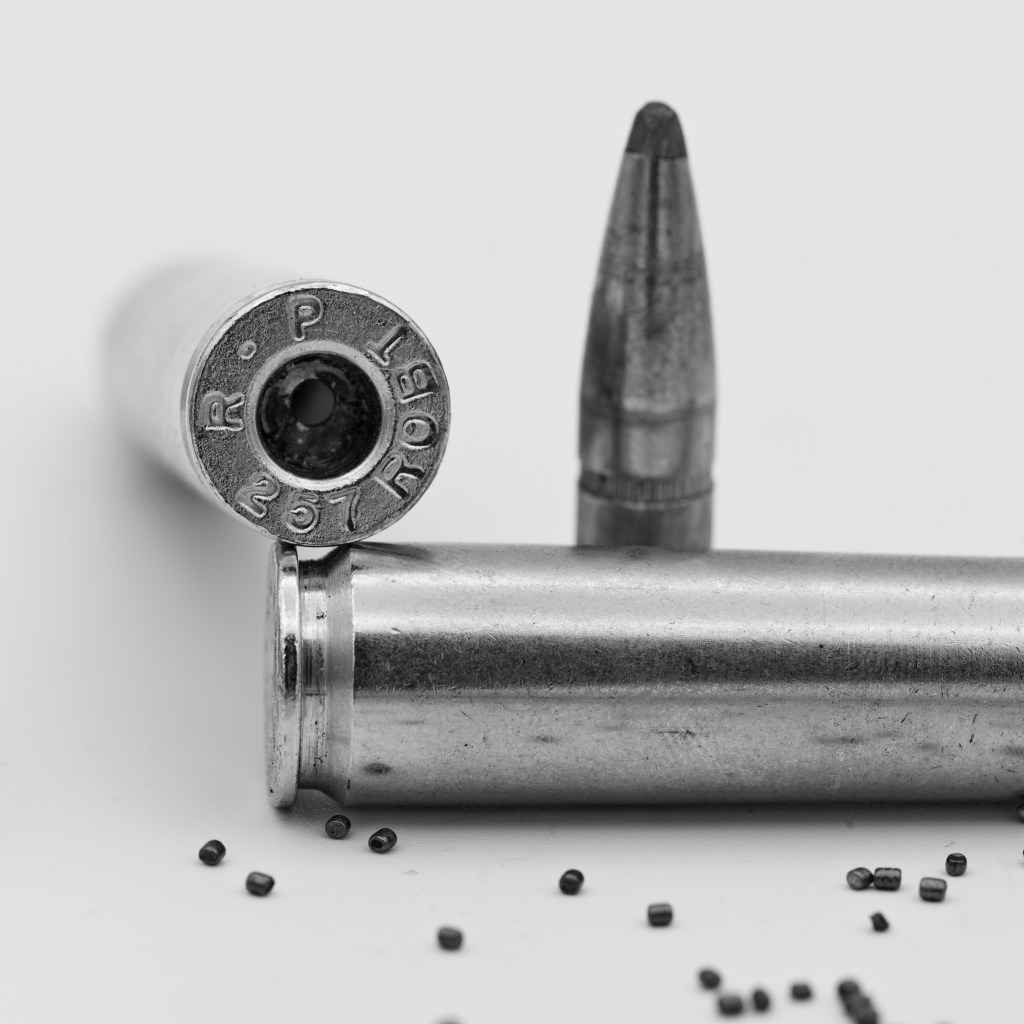
With all that said let’s talk about the .257 Roberts. This started life as a wildcat in the 1920’s. While many quarter bores were created by wildcatters at the time Ned Roberts is the one who takes most of the credit for this one. It was designed and based off the 7x57mm Mauser as during that time there was allot of relatively inexpensive Mauser actions and brass available.
In 1934 Remington Arms decided to introduce this as a commercially loaded option. While they made slight changes to the Wildcat that Ned Roberts created, they still credited him with the cartridge by calling the .257 Roberts.
Until the 6mm cartridges started to appear on the scenes the .257 Roberts and quarter bores took up most of the general use market. Loaded light with a 75gr projectile you could chase varmints and smaller game an then loading some of the heavier stuff like 117gr projectiles you had a cartridge more than adequate for larger game species.
I have wanted a quarter bore for a while now and may just have to get a .257 Roberts or potentially the Ackley Improved Version.
When looking at trajectory for the .257 Roberts let’s look at the 117gr Interlock loading from Hornady. Data shows it leaves the muzzle at 2780 fps. So, with a rifle that is zeroed at 100 yards we get the following drop data:
200 Yards: 3.87 inches of drop.
500 Yards: 59.54 inches of drop.
1000 Yards: 429.88 inches of drop.
(Please note the above trajectory information was pulled from http://gundata.org/ballistic-calculator/ )
Short Notes.
Official Name: .257 Roberts. (Also known as the .257 Bob.)
Year Designed: Wildcat in 1920s and Officially adopted in 1934.
Designed by: Ned Roberts.
Parent Case: 7x57mm Mauser
Rifling Twist Rate: 1 in 10”
Maximum Point-Blank Range: Roughly 300 yards.
I hope you enjoyed this brief overview of the .257 Roberts and will return next week for our Cartridge of the Week series.
Please remember to always practice safe muzzle control when dealing with firearms and happy shooting.
B
 B & R Photography
Leave a comment