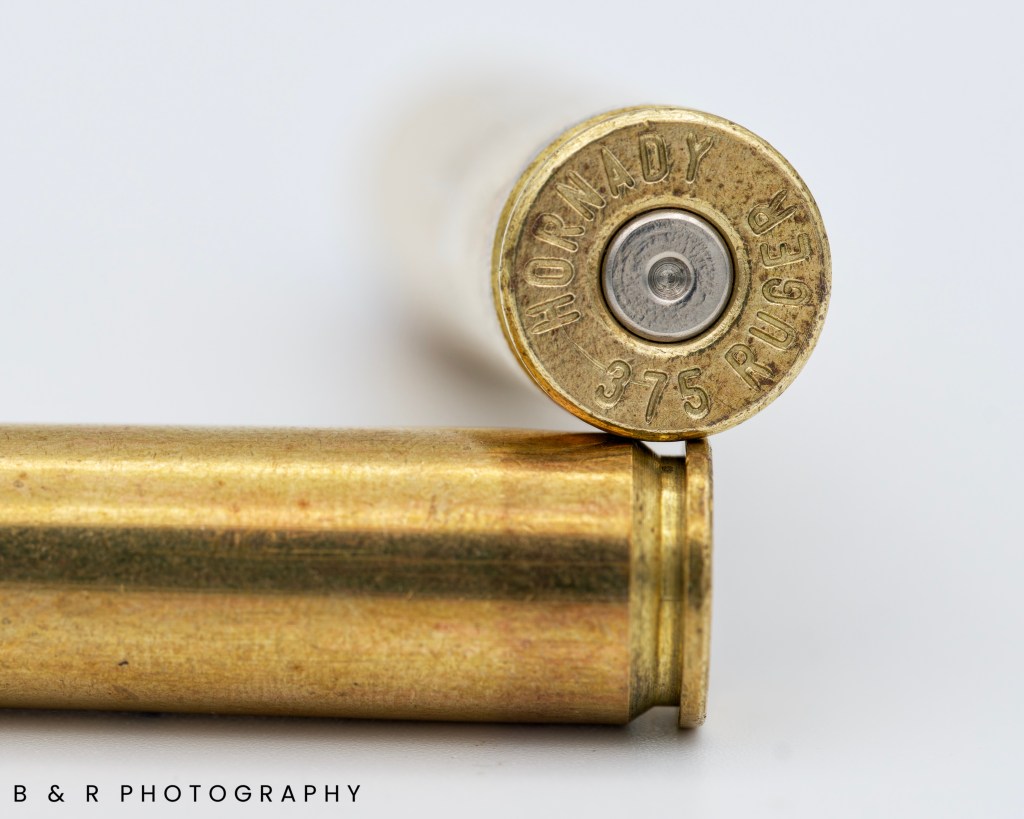
Alright you all know why we are here. This week let’s talk about the .375 Ruger, one of the newest .375 cartridges around. The cartridge was really designed with two places in mind (At least it my mind.) An that is Alaska and Africa as you can tell by looking at the two rifles chambered for it when released back in 2007. Ruger chambered the Ruger Hawkeye African and Ruger Hawkeye Alaskan rifle in .375 Ruger and if that does tell you this cartridge was designed for large dangerous game then I don’t know what will.
The .375 Ruger was designed via a partnership between Ruger and Hornady in 2007. They wanted to design a cartridge that could handle dangerous game, fire a .375 projectile and meet allot of the African country minimums. They wanted to make it slightly more compact so it could fit in a standard long action and have the advantages of a rimless and beltless case but still performing at the same level of the .375 H&H.
Thanks to its design the .375 Ruger while having a shorter overall length than the .375 H&H it has a 4% increase in powder capacity. Being a modern cartridge, it lacks a long taper and instead has a short almost nonexistent taper with very a sharp shoulder. This extra capacity leads to a roughly 150 to 200 fps increase in velocities compared to the .375 H&H factory loadings. (We aren’t talking about your custom handloads in a Ruger No.1 that can handle the extra stress.
Some factory loadings to consider are Hornady Superformance and Double Tap. The Hornady ammo loadings offer either a 270gr projectile or a 300gr projectiles traveling at 2,840 ft/s and 2,660 ft/s respectively. Both of these loadings offer quite the punch if needed.
As far as trajectory goes the we will use the .375 Ruger 270gr Interlock SP-RP loading from Hornady themselves. Leaving the muzzle at 2,840 ft/s with a zero of 100 yards we see the following drop.
200 Yards: 3.7 Inches.
300 Yards: 13.5 Inches.
500 Yards: 57.4 Inches.
(Please note the above trajectory information was pulled from https://www.hornady.com/team-hornady/ballistic-calculators/#!/ )
The factory load data was auto populated by the ballistics calculator on the Hornady website. So, if you notice an error I apologize. As I noticed an issue with the website information and have notified Hornady themselves.
Something else worth noting about this case is all the cases that have come to follow after its development. The .375 Ruger is the parent case to the following standardized cartridges: .300 Ruger Compact Magnum, .338 Ruger Compact Magnum, .416 Ruger, 300 Precision Rifle Cartridge, 6.5mm Precision Rifle Cartridge, 7mm Precision Rifle Cartridge and the .500 Bushwhacker. I know for a fact the .375 Ruger has been the parent to more cases but these are the ones currently recognized by an authority.
Short Notes.
Official Name: .375 Ruger (9.5×65.5mm).
Year Designed: 2007.
Designed by: Ruger & Hornady.
Parent Case: Unknown.
Rifling Twist Rate: 1 in 12”.
Maximum Point-Blank Range: Roughly 250 Yards.
I hope you enjoyed this brief overview of the .375 Ruger and will return next week for our Cartridge of the Week series.
Please remember to always practice safe muzzle control when dealing with firearms and happy shooting.
B
 B & R Photography
Leave a comment