As mentioned previously with these weekly cartridge blogs I want to try my best to go back and forth between rifle and handgun. While that may not be possible forever its possible for a few weeks, I hope.
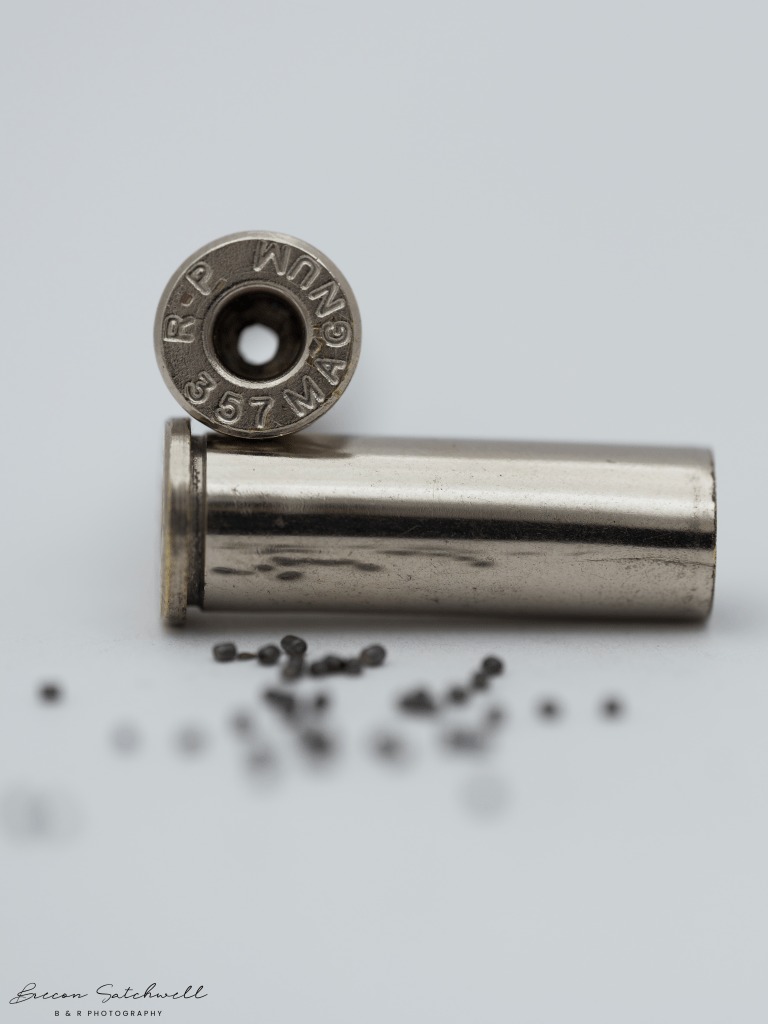
The .357 Magnum goes by a few names but everyone knows exactly what you’re talking about. It was a joint effort by Smith & Wesson alongside Winchester to compete with the .38 Super Automatic that colt released in the M1911 pistol. As the .38 Super was the first handgun cartridge released in the 1920s/1930s that could penetrate early ballistic vests and car doors. The reason this was an issue was the bootleggers and gangsters were using these means of cover during gunfights with law enforcement. The .357 Magnum was the revolver answer so that law enforcement agencies would stay with a revolver type firearm instead of switching to automatics. It was also developed to penetrate the items bootleggers and gangsters were using as cover during these shootouts.
The .357 Magnum was designed by Elmer Keith, Phillip B. Sharpe and Douglas B. Wesson and was introduced in 1935 with widespread success across both law enforcement and civilian markets.
The parent case to the .357 Magnum was the .38 Special which was the traditionally used law enforcement cartridge from its inception in the late 1890s however they needed something more powerful so why not make the case longer to fit more powder. This made sure that nobody would put the mor powerful .357 Magnum into a .38 Special handgun or carbine rifle.
You can find the .357 magnum chambered in Lever guns and Revolvers for the most part. (An likely single shot firearms as well) This cartridge is considered excellent for self-defense, metallic silhouette shooting and hunting. Also considered the minimum for lethality as far as the BC CFO is concerned when issuing wilderness-ATC’s in BC and the Yukon for trappers and works who qualify for said permit.
The original load for the .357 Magnum was a 158gr bullet travelling at 1525fps which was quite the stout loading even compared to todays standards as its mostly 125gr loads that reach those kinds of velocities.
As far as trajectory goes the .357 magnum using a standard loading of a 158gr Black Hills jacketed hollow point. Traveling at 1250 fps will give you the following drop in inches when zeroed at 25 yards:
30 Yards: 0.03 Inches.
50 Yards: 0.80 Inches.
80 Yards: 4.00 Inches.
(Please note the above trajectory information was pulled from https://gundata.org/blog/post/30-06-ballistics-chart/)
Keep in mind this data is based of an estimated sight over bore height of .75 inches and I do not have a .357 Magnum on hand to measure at this time.
Short Notes.
Official Name: .357 Magnum (.357 Smith & Wesson Magnum, .357 S&W Magnum or unofficially 9x33mmR)
Year Designed: 1934
Designed by: Elmer Keith, Phillip B. Sharpe and Douglas B. Wesson. (Joint effort for Smith & Wesson and Winchester.)
Parent Case: .38 Special
Rifling Twist Rate: 1 in 18.74 Inches
Maximum Point Blank Range Handgun: 119 Yards.
Maximum Point Blank Range Carbine: (Roughly) 149 Yards.
I hope you enjoyed this brief overview of the .357 Magnum and will return next week for our Cartridge of the Week series. An please feel free to write in if there is a cartridge you would like to hear about.
Please remember to always practice safe muzzle control when dealing with firearms and happy shooting.
B
 B & R Photography
Leave a comment